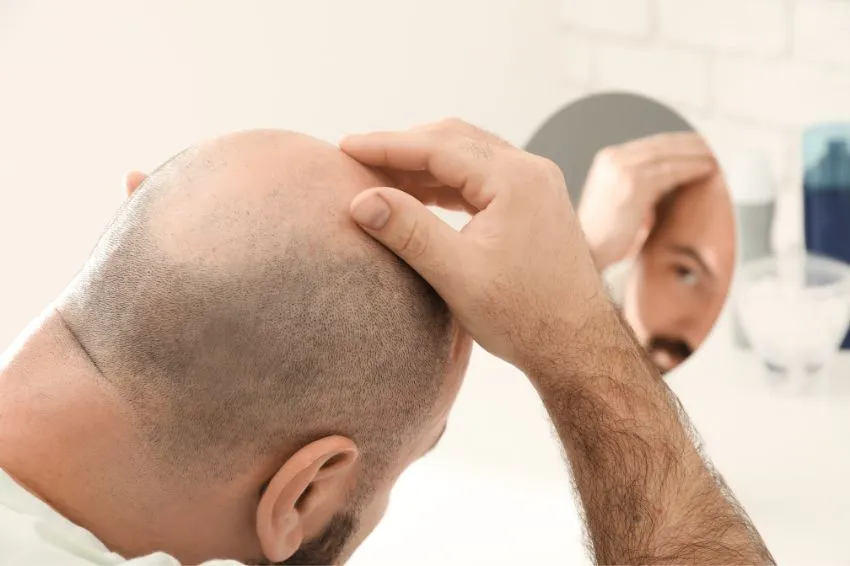
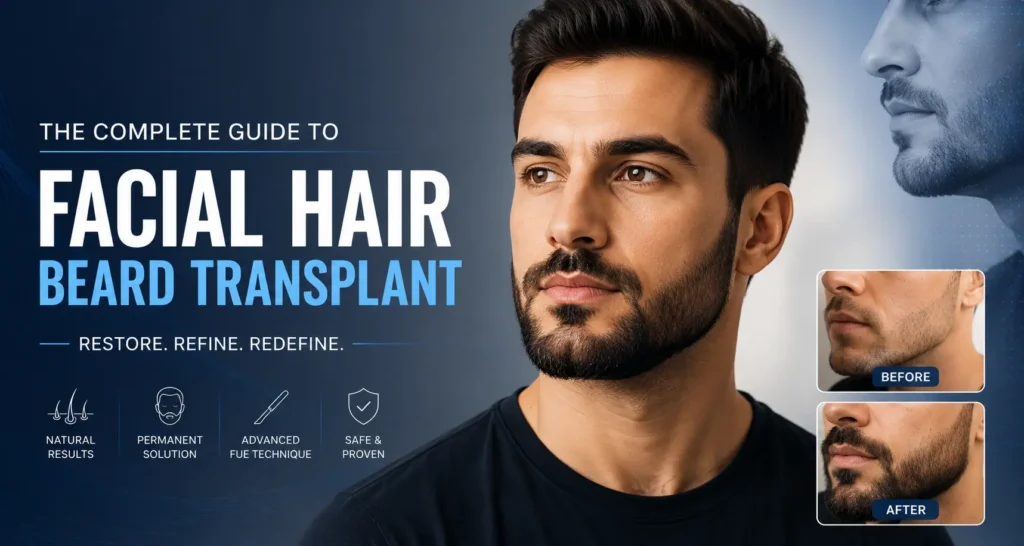
A full, well-defined beard or goatee is a central feature of modern male grooming. However, genetics, patchy growth patterns, surgical scars, or trauma can make growing dense facial hair difficult. If home remedies and oils have failed to deliver results, modern restoration offers a permanent medical solution: Facial Hair and Beard Transplants.
Using advanced micro-grafting techniques, hair restoration specialists can now create natural, dense, and permanent facial hair tailored to your unique facial features.
How Facial Hair Transplants Work
A facial hair transplant relies primarily on Follicular Unit Extraction (FUE). During this minimally invasive procedure, individual hair follicles are extracted from a healthy donor site—typically the back or sides of the scalp—and meticulously transplanted into thin or patchy areas of the face.
1. Donor Hair Extraction
Individual hair follicles are harvested using tiny micro-punches (usually less than 1mm). Because facial hair naturally consists of single-hair follicles (unlike scalp hair, which often grows in groups of 2, 3, or 4), your surgeon will select single-hair grafts to match natural facial density.
2. Micro-Grafting and Placement
The defining hallmark of a successful beard transplant is angulation. Facial hair does not grow straight out; it lies close to the skin and angled downward along specific growth lines. Your surgeon creates microscopic sites with precise directional depth to ensure every hair flows naturally into your jawline, mustache, or chin.
Popular Areas for Facial Hair Restoration
- Full Beard Density: Filling in sparse cheek areas and creating a strong, clean jawline contour.
- Goatee and Mustache Shaping: Defining symmetry around the upper lip and chin.
- Sideburn Restoration: Bridging the connection between scalp hair and beard lines.
- Scar Camouflage: Grafting directly over acne scars, surgical marks, or past trauma.
Who Is an Ideal Candidate?
While facial hair transplants are safe and effective, proper evaluation by an experienced surgeon is essential to determine if you are a good candidate.
| Candidacy Factor | Requirements & Considerations |
| Donor Hair Supply | Sufficient healthy donor hair at the back or sides of the scalp. |
| Type of Hair Loss | Ideal for genetic patchiness, injury scars, or stable alopecia barbae. |
| Overall Health | Non-smokers (or willing to pause), good healing ability, and realistic expectations. |
| Age | Men aged 22+ whose natural facial hair patterns have fully matured. |
What to Expect: Recovery and Growth Timeline
- Days 1–7 (Initial Healing): Tiny scabs form around each graft. Minor swelling or pinkness is normal and fades quickly.
- Weeks 2–4 (The Shedding Phase): The transplanted hair shafts will temporarily drop out. Do not worry—this is completely normal. The underlying hair root remains healthy and intact beneath the skin.
- Months 3–6 (Early Growth): Fine, new facial hairs begin emerging from the skin.
- Months 9–12 (Full Results): The transplanted hair matures into full thickness. You can shave, trim, groom, and style your new beard exactly like natural facial hair.
Medical Note: Always consult a board-certified hair restoration surgeon to evaluate your donor hair density and establish a custom surgical plan suited to your facial anatomy.